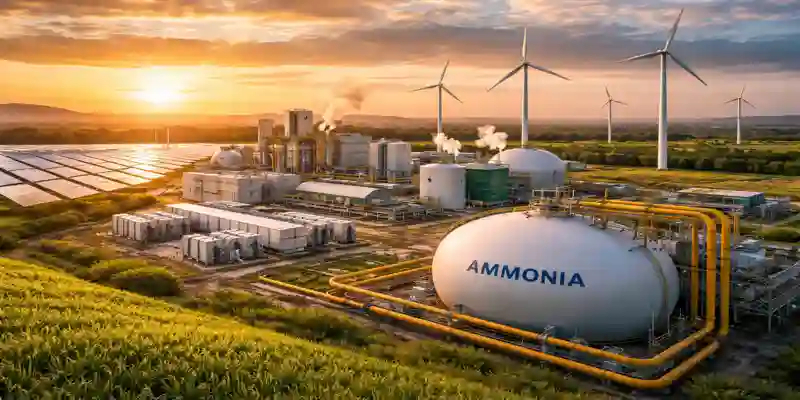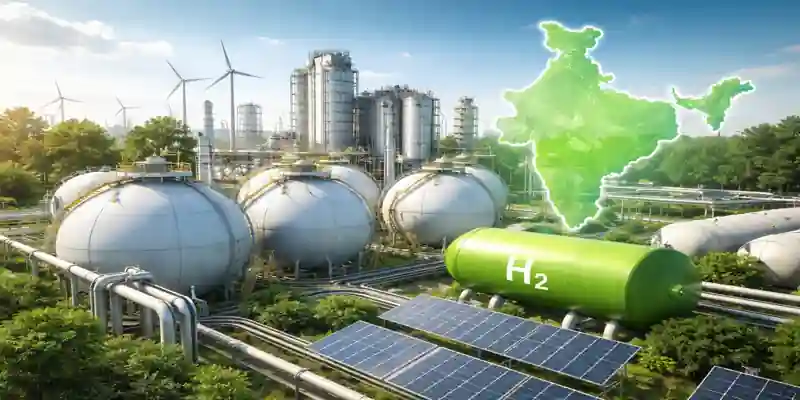

India is rapidly moving to position itself as a global leader in the Green Hydrogen economy. The National Green Hydrogen Mission (NGHM), launched in January 2023, plays a central role in this transition. It targets an annual production capacity of 5 million metric tons (MMT) by 2030. Moreover, the mission is backed by an investment of INR 19,744 crore (US$2.4 billion). As a result, it is expected to attract INR 8 lakh crore (US$91.95 billion) in investments, generate 500,000 new jobs, and cut 50 MMT of CO₂ emissions each year.
Why Green Hydrogen Matters for India
Green Hydrogen is critical because it can decarbonize industries that cannot easily switch to renewable electricity. These include steel, fertilizers, cement, refining, and heavy transport. In addition, its derivatives—such as green ammonia and methanol—offer solutions for international shipping and aviation. Consequently, Green Hydrogen strengthens both India’s clean energy targets and its global trade position.
India’s natural advantage lies in its abundant solar and wind energy. Thanks to these resources, the country can produce hydrogen at highly competitive rates. By 2030, production costs are projected to fall to INR 260–310/kg (US$3–3.7/kg). Therefore, India is well-placed to lead in both domestic adoption and global exports.
Market Potential at Home and Abroad
Globally, the Green Hydrogen market is expected to grow from US$8.8 billion in 2024 to US$199 billion in 2034. Furthermore, India’s own market could reach US$2.8 billion by 2030, expanding at an impressive 56% CAGR.
Export opportunities are equally promising. Under current plans, India could supply 10 MMT of Green Hydrogen per year to the EU, Japan, and South Korea. Consequently, the country could earn US$3–5 billion from exports and save US$7–15 billion through import substitution within the next decade.
Sectors Driving Green Hydrogen Use
Steel: Hydrogen-based steelmaking (H-DRI) can cut emissions by up to 90%. Moreover, pilot projects are already underway.
Fertilizers: By replacing natural gas with Green Hydrogen in ammonia production, India can reduce import dependence and stabilize prices.
Refineries: Electrolyzer-based hydrogen can gradually replace fossil fuel-derived hydrogen in refining processes.
Transport: Pilot projects are deploying hydrogen-powered buses, trucks, and refueling stations. As a result, India is testing hydrogen’s role in clean mobility.
Shipping & Aviation: Ports are preparing green ammonia bunkering facilities, while hydrogen-fueled ships and aircraft are being explored for long-term adoption.
Key Challenges
However, several challenges could slow progress.
High costs still make Green Hydrogen less attractive compared to grey hydrogen.
Limited infrastructure exists for pipelines, storage, and port handling.
India also depends heavily on imported minerals like platinum and iridium for electrolyzers.
In addition, renewable-rich states such as Rajasthan and Gujarat face water scarcity issues.
Finally, the absence of global standards for hydrogen safety and certification creates uncertainty for exporters.
Policy and State Support
To overcome these hurdles, the NGHM is supported by state-level initiatives. For example, Uttar Pradesh, Maharashtra, Rajasthan, Odisha, Andhra Pradesh, and West Bengal offer capital subsidies, tax breaks, and priority land allotments. Furthermore, the SIGHT program provides incentives for electrolyzer manufacturing and Green Hydrogen production. Consequently, both central and state policies are working in harmony to encourage industry participation.
Conclusion
In conclusion, India’s Green Hydrogen sector represents far more than an energy transition. It is also an economic growth engine that can create jobs, cut emissions, and reduce dependence on fossil fuel imports. Moreover, with strong government support, favorable renewable resources, and active private-sector participation, India is well on its way to becoming a global hub for Green Hydrogen production and exports.
❓ Frequently Asked Questions (FAQ) on India’s Green Hydrogen Sector
Q1. What is the National Green Hydrogen Mission (NGHM)?
The National Green Hydrogen Mission, launched in January 2023, aims to make India a global hub for Green Hydrogen. Its target is to produce 5 MMT annually by 2030, create 500,000 jobs, and cut 50 MMT of CO₂ emissions each year.
Q2. Why is Green Hydrogen important for India?
Green Hydrogen is vital for decarbonizing industries like steel, fertilizers, refining, and transport. It also supports energy security, reduces import dependency, and boosts India’s export potential.
Q3. What is India’s market potential for Green Hydrogen?
India’s Green Hydrogen market is expected to reach US$2.8 billion by 2030, with exports projected at 10 MMT per year to regions such as the EU, Japan, and South Korea.
Q4. Which sectors will benefit most from Green Hydrogen in India?
Key sectors include steel, fertilizers, refineries, transport, shipping, and aviation. Each of these sectors is exploring pilot projects and industrial adoption of Green Hydrogen.
Q5. What are the main challenges in Green Hydrogen adoption?
Major challenges include high production costs, limited infrastructure for pipelines and storage, import dependence on critical minerals, water scarcity in renewable-rich regions, and lack of harmonized global standards.
Q6. Which Indian states have Green Hydrogen policies?
States like Uttar Pradesh, Maharashtra, Rajasthan, Odisha, Andhra Pradesh, and West Bengal have announced policies with subsidies, tax breaks, and land allotments to attract Green Hydrogen investments.
Q7. What is the export potential of India’s Green Hydrogen?
India could capture 10% of the global Green Hydrogen trade, earning US$3–5 billion in exports and saving US$7–15 billion in imports within the next decade.
ey-investment-opportunities-in-india-s-green-hydrogen-sector