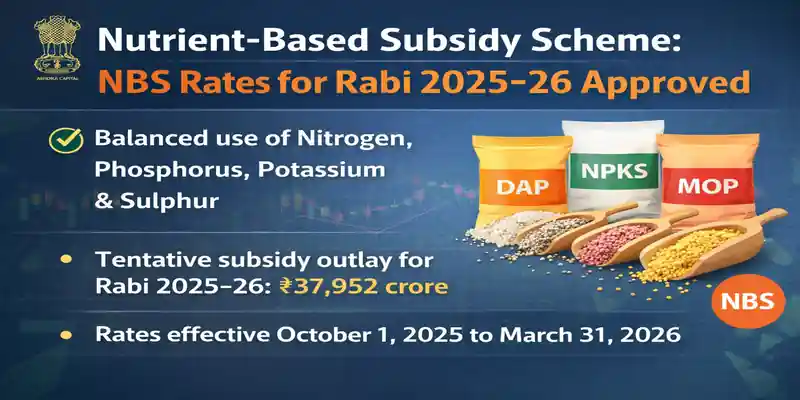

NBS Rates for Kharif 2026 have been approved by the Union Cabinet chaired by Narendra Modi. The decision aims to ensure the availability of subsidized fertilizers to farmers during the upcoming Kharif season.
The Nutrient Based Subsidy (NBS) will be applicable from 01 April 2026 to 30 September 2026. The government has estimated a total budgetary requirement of around Rs.41,533.81 crore for this period. This marks an increase of approximately Rs.4,317 crore compared to the Kharif 2025 budget.
Higher Subsidy Allocation to Support Farmers
The increase in NBS Rates for Kharif 2026 reflects rising global fertilizer prices. Inputs such as Urea, DAP, MOP, and sulphur have seen price fluctuations in international markets.
With higher subsidy allocation, the government aims to protect farmers from price volatility. This move will help maintain stable retail prices of fertilizers across India.
Affordable P&K Fertilizers Ensured
Under the approved scheme, subsidy will be provided on Phosphatic and Potassic (P&K) fertilizers, including DAP and various NPKS grades. The subsidy will be released to fertilizer manufacturers and importers based on fixed nutrient rates.
This ensures that farmers can purchase fertilizers at affordable and reasonable prices. The availability of fertilizers during the sowing season is critical for crop productivity.
Implementation Strategy for Kharif 2026
The implementation of NBS Rates for Kharif 2026 will follow the existing NBS framework. The subsidy system, introduced in 2010, covers 28 grades of P&K fertilizers.
The government will monitor supply and distribution closely. This will ensure smooth availability across all states during the peak agricultural season.
Background of NBS Scheme
The Nutrient Based Subsidy scheme was introduced on 01 April 2010 to promote balanced fertilization. It encourages the use of different nutrients like nitrogen, phosphorus, potassium, and sulphur.
With the approval of NBS Rates for Kharif 2026, the government continues its farmer-friendly approach. The focus remains on ensuring food security and supporting agricultural growth.
| Grades | 2025-26 (Rabi) | 2026-27 (Kharif) | % Change |
|---|---|---|---|
| AS (20.5-0-0-23) | 9,479 | 10,427 | 10% |
| DAP (18-46-0-0) | 29,805 | 32,787 | 10% |
| MAP (11-52-0-0) | 29,671 | 32,640 | 10% |
| MOP (0-0-60-0) | 1,428 | 1,428 | 0% |
| NP (20-20-0-0) | 18,196 | 20,016 | 10% |
| NP (28-28-0-0) | 25,474 | 28,022 | 10% |
| NP (24-24-0-0) | 21,835 | 24,019 | 10% |
| NPK (10-26-26-0) | 17,390 | 19,068 | 10% |
| NPK (12-32-16-0) | 20,890 | 22,942 | 10% |
| NPK (14-28-14-0) | 19,785 | 21,731 | 10% |
| NPK (14-35-14-0) | 23,142 | 25,424 | 10% |
| NPK (15-15-15-0) | 14,004 | 15,369 | 10% |
| NPK (17-17-17-0) | 15,871 | 17,418 | 10% |
| NPK (19-19-19-0) | 17,738 | 19,467 | 10% |
| NPK (16-16-16-0) | 14,938 | 16,394 | 10% |
| NPKS (15-15-15-9) | 14,262 | 15,653 | 10% |
| NPS (16-20-0-13) | 16,848 | 18,534 | 10% |
| NPS (20-20-0-13) | 18,569 | 20,427 | 10% |
| NPS (24-24-0-8) | 21,835 | 24,272 | 11% |
| SSP (0-16-0-11) | 7,408 | 8,789 | 19% |
| TSP (0-46-0-0) | 22,062 | 24,270 | 10% |
| NP (14-28-0-0) | 19,452 | 21,398 | 10% |
| NPK (8-21-21-0) | 14,013 | 15,365 | 10% |
| NPK (9-24-24-0) | 15,953 | 17,492 | 10% |
| PDM (0-0-14.5-0) | 345 | 345 | 0% |
| Urea-SSP Complex (5-15-0-10) | 9,088 | 10,596 | 17% |
| NPK (11-30-14-0) | 19,453 | 21,366 | 10% |
| SSP (Fortified grade) (16-0-11-0) | 7,408 | 8,789 | 19% |