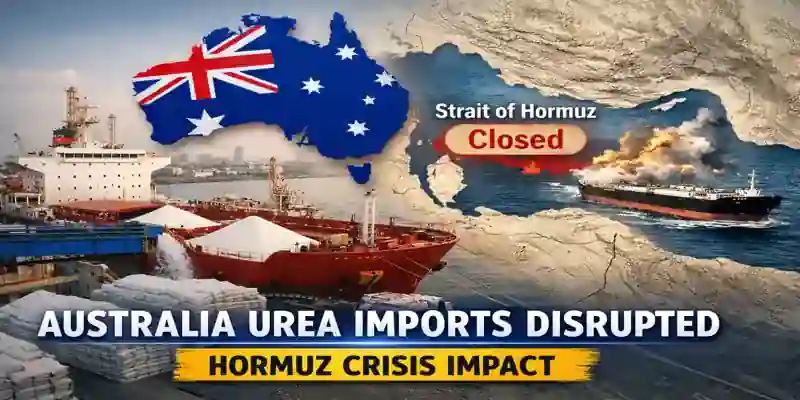
Australia urea imports are under pressure as disruptions around the Strait of Hormuz restrict supply from the Middle East. Importers are now searching for alternative sources, but strict AQIS rules and limited approvals are creating fresh challenges.
Australia Urea Imports Shift Away from Middle East Supply
In recent weeks, buyers have started exploring supplies from Egypt and Nigeria. However, these origins face challenges under Australian Quarantine and Inspection Service (AQIS) biosecurity rules.
Neither country has a consistent track record of meeting AQIS standards. Australia classifies supply chains under four AQIS levels. Unapproved origins fall under level 3, which requires full inspection and creates delays.
Nigeria’s Indorama facility has reportedly achieved level 2 clearance. Still, Australia has not imported any Nigerian urea so far, according to trade data.
Alternative Suppliers Challenge Australia Urea Imports
The Middle East typically supplies nearly two-thirds of Australia’s annual urea imports. Southeast Asia accounts for most of the remaining volumes.
At the same time, Middle East producers have already committed large volumes to India. Around 300,000 tonnes of urea remain stuck awaiting passage through Hormuz. Market participants expect additional tenders, which could further tighten availability even if the route reopens.
Supply Adequate for Now, But Risks Ahead
Australia currently holds enough urea to support winter crop pre-seeding demand. However, importers must secure additional volumes for topdressing during June–July.
So far in 2026:
- Around 510,000 tonnes have arrived in Australia
- Nearly 215,000 tonnes are still in transit across eight vessels
Industry Calls for Policy Support
Importers are urging the government to relax AQIS rules, especially for level 3 classifications that increase costs and delay cargo handling.
Fertilizer Australia has also requested the government to ease restrictions on Russian fertilizer imports. Currently, Russian products lack accreditation from the Department of Agriculture, Fisheries and Forestry and cannot enter the Australian market.
The government is considering policy changes, including financial guarantees and loan support to secure imports. Although these measures target fuel supply, fertilizer importers may also benefit.
AQIS Rules Impact Australia Urea Imports
AQIS rules continue to limit sourcing flexibility. The agency evaluates the entire supply chain—from plant to vessel—rather than individual components.
If any part of the chain receives a level 3 rating, authorities classify the entire shipment under level 3. This rule also applies to mixed cargoes from multiple origins.
AQIS classification system:
- Gold: No checks (top-performing supply chains)
- Level 1: Random berth inspections
- Level 2: Detailed checks during unloading and storage
- Level 3: Full inspection and product isolation
Vessels undergo separate classification under the AFF1 and AFF2 system, with AFF1 representing the higher standard.
Direct plant-to-vessel loading offers the easiest path to approval. In contrast, mixed-use ports, uncovered conveyors, and shared logistics systems increase the risk of level 3 classification.
Outlook
Importers face significant uncertainty as they explore new supply sources. Even after inspection, AQIS does not guarantee level 1 approval.
Despite these risks, securing alternative supplies remains critical to support wheat and barley topdressing demand in mid-2026.