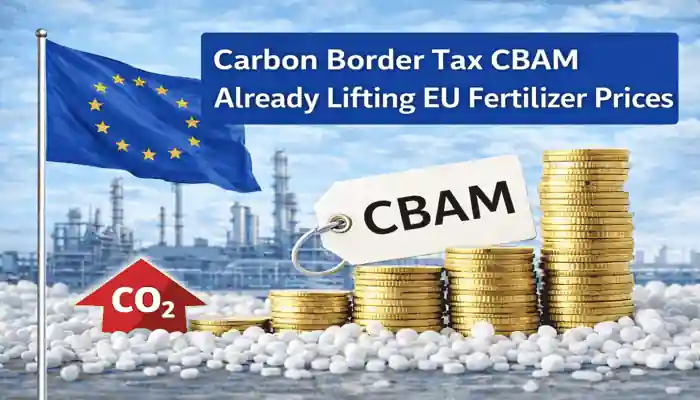
Carbon Border Tax CBAM is already lifting EU fertilizer prices, as the European Union begins embedding carbon costs into nitrogen and fertilizer imports. Market participants report that Carbon Border Tax CBAM is influencing pricing behavior even before its full enforcement phase.
Insights shared by Yara indicate that the CBAM is reshaping trade flows and strengthening price support for fertilizers produced within the European Union.
Carbon Border Tax CBAM Raises Cost of Fertilizer Imports
Under the CBAM framework, fertilizer imports face additional charges based on their carbon intensity. Products such as urea, ammonia, and other nitrogen fertilizers imported into the EU typically carry higher embedded emissions.
As a result, CBAM is raising the landed cost of imported fertilizers, making them less competitive against EU-produced material. This cost increase is now being reflected in benchmark fertilizer prices across Europe.
Carbon Border Tax CBAM Gives EU Producers a Pricing Advantage
European fertilizer producers benefit directly from CBAM due to lower emission intensity and compliance with EU environmental regulations. Investments in cleaner ammonia sourcing, energy efficiency, and decarbonization have reduced carbon exposure for EU plants.
Yara noted that CBAM allows EU producers to recover higher production costs while maintaining competitiveness against imports.
Carbon Border Tax CBAM Already Reflected in Nitrogen Prices
Although CBAM is still in its transition stage, buyers and traders are already pricing in future carbon costs. This has widened the gap between European fertilizer prices and imports from high-emission regions.
The impact of CBAM is particularly visible in nitrogen fertilizers, where carbon costs form a significant share of total production expenses.
Impact of CBAM on Global Fertilizer Trade
CBAM is also reshaping global fertilizer trade flows. Exporters to Europe must now account for carbon costs when calculating netbacks, which could redirect volumes toward other markets.
For import-dependent countries like India, tighter fertilizer availability in Europe may indirectly support global prices during peak demand seasons.
CBAM to Keep EU Fertilizer Prices Supported
Yara expects CBAM to play a growing role in fertilizer pricing as full implementation approaches. Carbon-efficient producers are likely to gain a structural advantage, while high-emission suppliers may lose access to premium EU markets.
In the medium term, CBAM is expected to keep EU fertilizer prices supported, alongside lower gas prices and tight nitrogen supply.