The Government of India has strengthened the fertilizer supply chain India to ensure smooth logistics and timely availability across all States, especially during peak agricultural seasons.
In a written reply in the Rajya Sabha, Anupriya Patel said that authorities assess fertilizer demand before every cropping season. The Department of Agriculture and Farmers Welfare works with State Governments to estimate state-wise and monthly requirements.
Based on these projections, the Department of Fertilizers issues monthly supply plans and monitors availability closely.
Digital Monitoring Improves Fertilizer Logistics
The government tracks fertilizer movement through the Integrated Fertilizer Management System (iFMS). This system helps ensure transparency and efficient distribution.
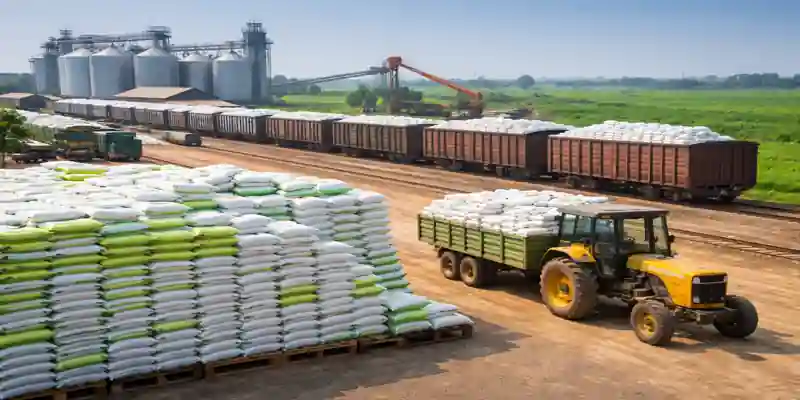
State Governments coordinate with manufacturers and importers for timely indent placement. At the same time, regular meetings with the Ministry of Railways ensure adequate rake availability and priority transportation of fertilizers.
To address demand-supply gaps, the government also plans advance imports to maintain sufficient stock levels.
Adequate Fertilizer Availability in Rabi 2025-26 Season
During the ongoing Rabi 2025-26 season, fertilizers such as Urea, DAP, MOP, and NPK have remained adequately available across all States.
Under the Urea Subsidy Scheme, farmers continue to get urea at a maximum retail price of ₹242 per 45 kg bag (excluding neem coating charges and taxes). The government provides the subsidy difference directly to manufacturers and importers.
Nutrient Based Subsidy Supports Affordable Fertilizers
The government implements the Nutrient Based Subsidy (NBS) Scheme for Phosphatic and Potassic fertilizers. Under this policy, subsidies depend on nutrient content and are provided at the point of sale.
Authorities also monitor global fertilizer and raw material prices. They adjust subsidy rates annually or bi-annually to keep fertilizers affordable.
For Kharif 2025 and Rabi 2025-26, the government has provided additional support of ₹3500 per MT. This support covers logistics costs, price fluctuations, GST impact, and a reasonable return of 4% on net MRP.
Strict Action Against Fertilizer Bundling and Overpricing
Fertilizers fall under the Essential Commodities Act, 1955 and the Fertilizer Control Order, 1985. These laws empower State Governments to act against malpractices such as forced bundling or overpricing.
The Department of Fertilizers discourages tagging non-essential products with fertilizers. It has issued clear instructions to companies to avoid such practices.
If complaints arise, authorities forward them to State Governments for strict action under existing laws.
Focus on Efficient Supply and Farmer Protection
These steps show the government’s strong focus on improving the fertilizer supply chain India. The measures aim to ensure efficient logistics, balanced distribution, and affordable prices.
At the same time, they protect farmers from unfair practices and ensure timely fertilizer availability during critical agricultural periods.