
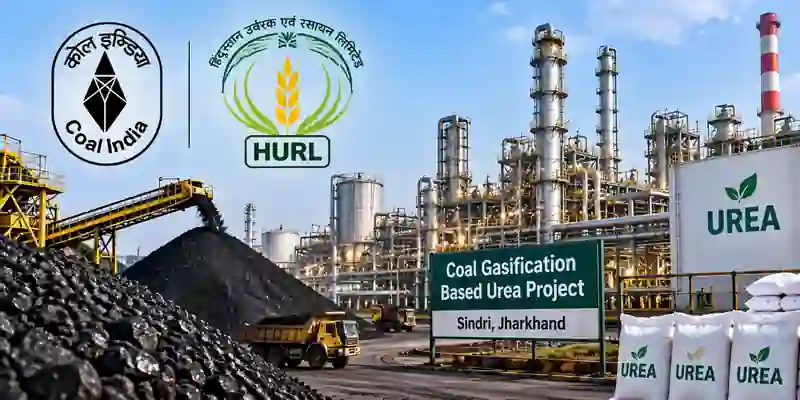
Coal India Ltd and Hindustan Urvarak & Rasayan Limited (HURL) have signed a non-binding MoU to explore the development of a coal gasification-based urea production facility at Sindri in Jharkhand.
Coal India disclosed the agreement in a regulatory filing on September 28, 2026. The proposed project would examine the use of coal gasification technology to convert coal into a feedstock for fertiliser production.
The agreement is currently at an exploratory stage and does not represent a final investment commitment.
Coal India HURL MoU: Key Details
The Coal India HURL MoU focuses on evaluating the feasibility of a coal gasification-based urea project at Sindri.
| Parameter | Details |
|---|---|
| Parties | Coal India Ltd and HURL |
| Agreement | Non-binding MoU |
| Proposed technology | Coal gasification-based urea production |
| Location | Sindri, Jharkhand |
| Disclosure date | September 28, 2026 |
| Project stage | Exploratory |
| Next step | Feasibility assessment |
Because the MoU is non-binding, the companies have not committed to a specific investment amount, production capacity or commissioning timeline.
Coal Gasification Urea Project: How It Works
Coal gasification converts coal into synthesis gas, commonly known as syngas. The gas primarily contains carbon monoxide and hydrogen and can subsequently be processed into chemical feedstocks.
For fertiliser production, the technology can provide a pathway from coal to ammonia and eventually urea.
This is different from conventional coal-fired power generation, where coal is primarily burned to produce heat and electricity.
The proposed project would instead use coal as a chemical feedstock for fertiliser manufacturing.
Why Coal Gasification Matters for Urea Production
India relies heavily on natural gas as a feedstock for domestic urea production. Therefore, developing alternative feedstocks could help diversify the country’s fertiliser manufacturing base.
Coal gasification offers one potential pathway because India has substantial domestic coal resources.
The technology could potentially allow coal to be converted into synthesis gas and subsequently into ammonia and urea.
However, the economic and environmental viability of such a project will depend on factors including technology selection, coal quality, capital costs, operating costs, emissions management and regulatory approvals.
Why Sindri Is Important for the Project
Sindri has a long history in India’s fertiliser industry and remains an important location for domestic urea production.
HURL operates the Sindri fertiliser complex as part of its broader mandate to revive and modernise fertiliser production capacity.
The location could therefore provide an existing industrial ecosystem for exploring a new coal-based fertiliser project.
Coal India’s involvement adds another strategic element because the company can provide expertise in coal mining and coal supply, while HURL brings experience in fertiliser manufacturing and operations.
HURL and Coal India Partnership
HURL was established as a joint venture involving Coal India, NTPC, IRCON International and Fertilizer Corporation of India.
The company was created to revive dormant fertiliser production facilities and strengthen India’s domestic urea manufacturing capacity.
The new Coal India HURL MoU builds on the existing relationship between the two organisations while exploring a different technology pathway for fertiliser production.
Coal India Expands Beyond Coal Mining
The proposed Sindri project is also consistent with Coal India’s broader diversification strategy.
The company has been exploring downstream applications for coal, including coal gasification and coal-to-chemicals projects.
Instead of limiting coal to conventional mining and sales, gasification could allow Coal India to participate in higher-value downstream applications.
However, the Sindri project remains at an early stage. A feasibility assessment and subsequent approvals would be required before any final investment decision.
What Happens After the Coal India HURL MoU?
The next major milestone will be the feasibility assessment for the proposed coal gasification-based urea facility.
Several factors will determine whether the project moves forward, including:
- Technical feasibility of coal gasification
- Availability and quality of suitable coal
- Estimated project investment
- Urea production capacity
- Technology and operating costs
- Environmental and regulatory approvals
- Availability of supporting infrastructure
- Commercial viability of coal-based urea production
A transition from the current non-binding MoU to a definitive agreement would represent a significant step forward.
Coal India HURL MoU: What to Watch
The Coal India HURL MoU represents an early-stage effort to explore coal gasification as an alternative feedstock pathway for urea production.
For Coal India, the project could support its diversification into coal-to-chemicals applications. For HURL, it provides an opportunity to explore another technology pathway at a location with an established fertiliser-industry presence.
For now, however, the project remains exploratory. The feasibility study, investment requirements, project capacity and subsequent approvals will determine whether the proposed Sindri coal gasification-based urea plant progresses to the next stage.