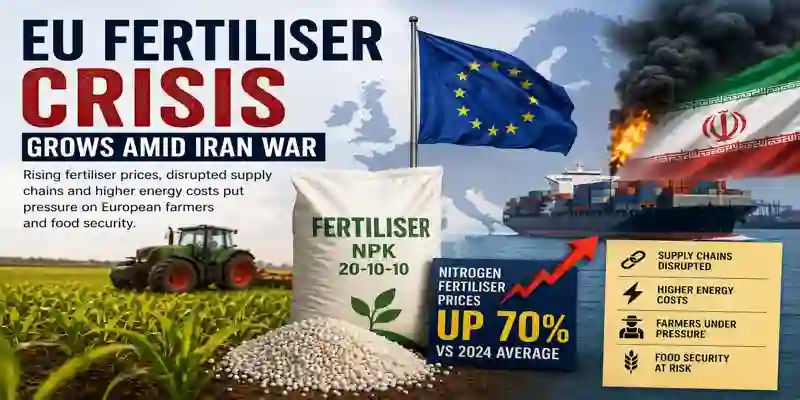
The EU fertiliser crisis is worsening as the Iran war disrupts global supply chains and increases nitrogen fertiliser prices across Europe. European Union ministers are now discussing emergency measures to protect farmers and secure fertiliser supplies amid rising energy and import costs.
The European Commission is now pushing a new Fertiliser Action Plan aimed at protecting farmers from soaring input costs while strengthening Europe’s food security and domestic fertiliser industry.
EU Fertiliser Crisis Intensifies After Iran Conflict
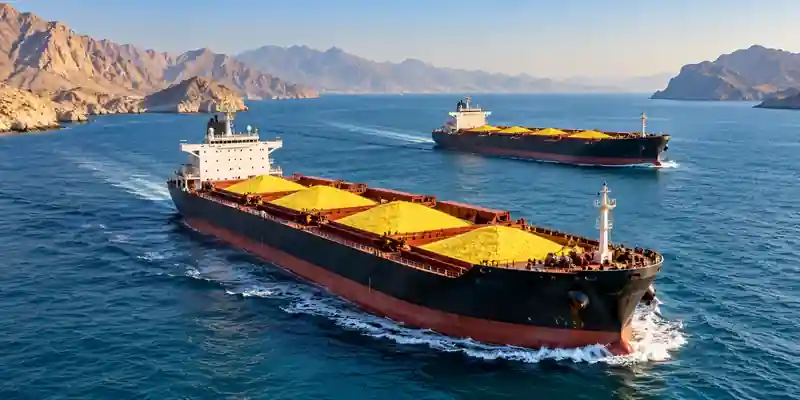
The Strait of Hormuz normally handles nearly one-third of the world’s seaborne fertiliser shipments. Ongoing tensions linked to the US-Israel war on Iran have disrupted shipping activity, increasing freight costs and energy prices across global markets.
Although the European Union imports only a limited share of fertiliser directly from the Middle East, the region’s instability has triggered sharp increases in global fertiliser and natural gas prices. European nitrogen fertiliser production depends heavily on imported gas, making the industry vulnerable to energy market fluctuations.
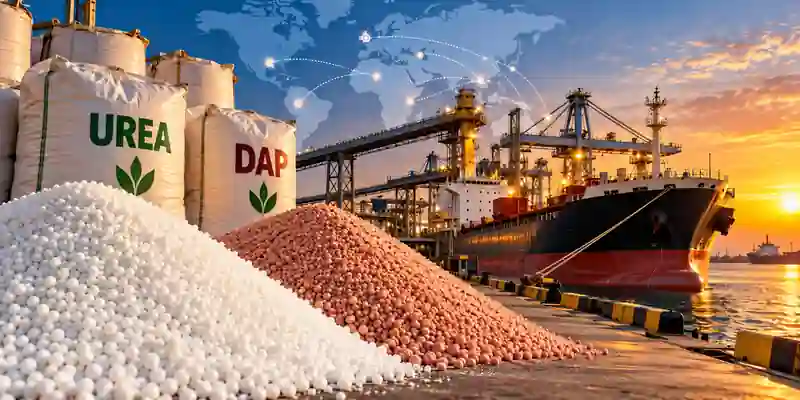
According to EU data, Europe imported around 2 million tonnes of ammonia, 5.8 million tonnes of urea, and 6.7 million tonnes of nitrogen fertilisers and mixtures during 2024.
Iran War Disrupts Global Fertiliser Supply Chains
The European Commission reported that nitrogen fertiliser prices in Europe are currently about 70 percent higher than their 2024 average. Rising costs are increasing pressure on farmers already struggling with expensive fuel, energy, and agricultural inputs.
The situation has revived memories of the 2022 Russia-Ukraine war, when soaring gas prices forced several European fertiliser plants to reduce or temporarily halt production due to unprofitable operations.
Nitrogen Fertiliser Prices Rise Across Europe
The proposed EU Fertiliser Action Plan includes several emergency measures designed to stabilize the market and support farmers:
- Emergency financial support through the EU agricultural budget
- Liquidity assistance schemes for farmers
- Flexible advance payments under the Common Agricultural Policy
- Possible fertiliser stockpiles for supply security
- Measures to increase imports from countries outside Russia and Belarus
- Support for bio-based and sustainable fertiliser alternatives
In addition, the EU plans to suspend import duties on certain nitrogen fertilisers, including urea and ammonia, sourced from countries other than Russia and Belarus. Current import tariffs range between 5.5 percent and 6.5 percent.
The Reuters news agency estimated that the tariff suspension could save importers nearly 60 million euros.
EU Fertiliser Action Plan Targets Supply Security
The impact of the fertiliser crisis varies across Europe. Ireland remains one of the most exposed countries due to its heavy dependence on imported fertilisers and limited domestic production capacity.
Ireland imported approximately 1.7 million tonnes of fertiliser in 2025. The country’s livestock-focused agricultural sector relies heavily on nitrogen fertilisers for grassland production, making farmers highly sensitive to price increases.
Meanwhile, countries such as Finland and Sweden are strengthening strategic fertiliser stockpiles as part of broader food security and defense planning.
Which European Countries Face the Highest Risk?
The fertiliser crisis has also exposed policy divisions within the European Union.
Countries like Italy and France are seeking relief from the EU’s Carbon Border Adjustment Mechanism, arguing that additional carbon-related costs are hurting farmers during a period of economic stress.
However, environmental groups have warned against weakening nitrogen pollution regulations, saying relaxed rules could increase water contamination and environmental damage.
Poland and Germany, both major fertiliser producers, are more focused on protecting domestic industry and oppose measures that could weaken local manufacturers.
Could the EU Fertiliser Crisis Raise Food Prices?
EU officials do not expect an immediate food price surge because many farmers are still using fertiliser purchased before the current supply disruptions began.
However, experts warn that higher fertiliser costs may gradually impact food prices later in 2026. Since fertilisers influence crop production months before food reaches consumers, the effects are usually delayed by up to six months.
The European Commission says its strategy combines short-term support with long-term efforts to strengthen Europe’s fertiliser production capacity and reduce dependence on imported supplies.
As global energy and fertiliser markets remain volatile, the EU is increasingly focused on protecting both food security and farmer competitiveness across the region.