

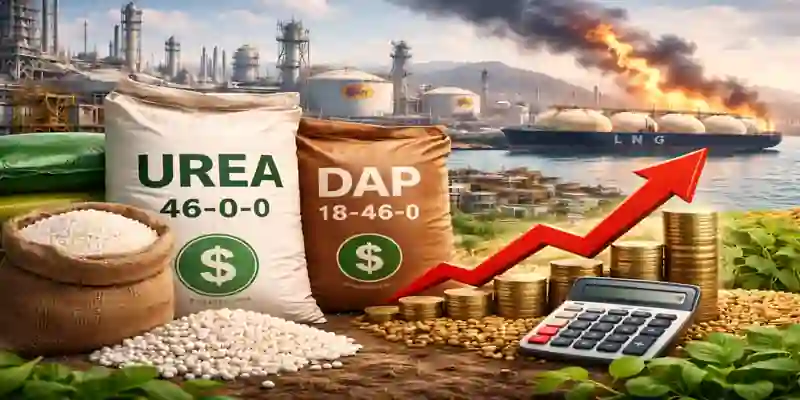
Global fertilizer prices increase as tensions in the Gulf region disrupt energy and shipping routes. The rising conflict is already affecting fertilizer markets, including India.
Prices of crude oil and liquefied natural gas (LNG) are climbing rapidly. As a result, the cost of key fertilizers such as urea and DAP (Diammonium Phosphate) is also rising.
Market experts warn that if the conflict continues, urea prices could cross $1,000 per ton in the global market.
Gulf Conflict Driving Fertilizer Prices Increase
Military tensions in the Middle East have disrupted energy supply and fertilizer trade.
Egypt recently purchased urea at $492 per ton. However, after military activity intensified in West Asia, the price quickly rose to around $530 per ton.
Similarly, DAP prices, which were about $750 per ton, are expected to approach $1,000 per ton if the crisis continues.
Rising Demand in India Before Sowing Season
India is approaching its major sowing season. Farmers require large quantities of fertilizers such as urea and DAP during this period.
When demand rises and supply becomes uncertain, fertilizer prices increase rapidly in international markets.
This situation has created concern across the fertilizer industry and among agricultural policymakers.
India Highly Dependent on Fertilizer Imports
India imports a significant portion of its fertilizer requirements.
For phosphate and potash fertilizers, the country depends on more than 90% imports.
Large phosphate reserves are located in Morocco, which holds nearly 70% of the world’s phosphate reserves. Meanwhile, Canada and Belarus are among the largest producers of potash.
According to data from the Fertiliser Association of India, between April and December of FY 2025-26:
Urea sales increased 3.8% to 31.16 million tons
Domestic production declined 3% to 22.44 million tons
Imports surged 85% to around 8 million tons
This shows that India is increasingly relying on fertilizer imports.
Government Monitoring Rising Fertilizer Prices
In India, urea imports are controlled by the government.
Last year, fertilizer imports declined. However, when reports of fertilizer shortages emerged, the government decided in September to increase imports significantly.
Several agencies were instructed to issue tenders to ensure fertilizer availability during the upcoming agricultural season.
However, higher global prices mean the government may need to provide more fertilizer subsidies.
The subsidy budget for phosphate and potash fertilizers was initially ₹49,000 crore. It was later increased to ₹60,000 crore and then revised to ₹54,000 crore.
Strait of Hormuz Risks for Energy and Fertilizer Supply
Energy supply disruptions are a key factor behind the fertilizer prices increase.
QatarEnergy supplies nearly 40% of India’s LNG imports.
In addition, about 55% of India’s LNG shipments pass through the Strait of Hormuz.
If tensions escalate or shipping routes are blocked, both energy and fertilizer supply chains could be affected.
Global shipping giant Maersk has also suspended operations in parts of the region due to security concerns.
Impact on India’s Agricultural Trade
According to Indian Micro Fertilizers Manufacturers Association, disruptions in the Strait of Hormuz could significantly impact India’s agricultural supply chain.
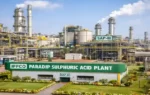
Raw materials such as sulfur and phosphoric acid, which are essential for fertilizer production, may face supply delays.
This would further increase production costs for fertilizer manufacturers.
What Rising Fertilizer Prices Mean for Farmers
If fertilizer prices increase further, the cost of farming will also rise.
Higher fertilizer costs could put pressure on farmers during the upcoming sowing season.
The government is trying to ensure that fertilizers remain available at stable prices. However, much will depend on how the geopolitical situation in the Gulf region evolves.