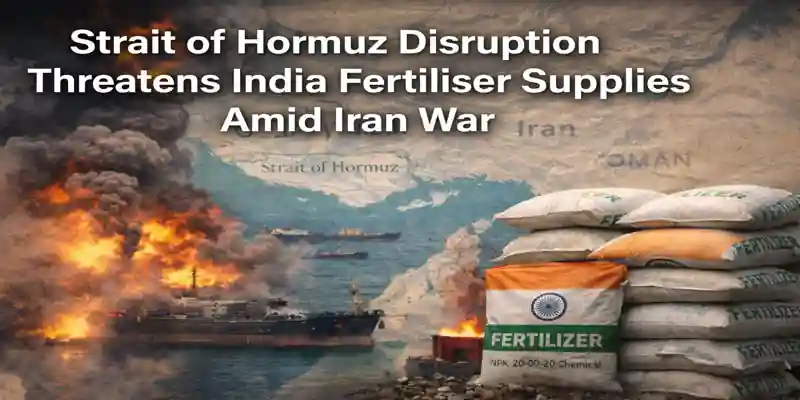
India urea supply 2026 is under pressure as the ongoing Iran war disrupts global gas markets, raising concerns over fertilizer availability ahead of the crucial kharif season. With agriculture heavily dependent on timely urea supply, any disruption could push up costs and impact crop output across the country.
Gas Volatility Raises Urea Production Concerns
The biggest challenge stems from volatile natural gas supplies, a key input in urea production. According to industry experts, production levels in the coming months will largely depend on gas availability.
The government has already stepped in, directing fertilizer companies to prioritize urea production by diverting all available ammonia toward it. This move is expected to marginally boost domestic output, but concerns remain.
A former official from the Fertiliser Association of India noted that “the gas supply situation is volatile now and urea production will depend on it,” highlighting the fragility of the supply chain.
Domestic Producers Struggle with Capacity Constraints
Major fertilizer producers are operating under constrained conditions:
IFFCO is currently running only three of its five urea plants at full capacity, utilizing about 65% of allocated gas.
Kribhco is operating its Hazira unit below capacity due to insufficient gas supply, despite being one of India’s largest single-location urea producers.
National Fertilizers Limited has four out of five plants operational, also running at around 65% capacity, with one unit under maintenance.
Although gas supplies have improved to around 65% of demand, several companies are still not receiving adequate allocations, adding to uncertainty.
Kharif Season Demand and Supply Outlook
India’s urea demand during the kharif season remains substantial. In 2025, demand was estimated at 18.54 million tonnes but actual sales rose to 19.32 million tonnes. While estimates for 2026 are yet to be finalized, demand is expected to remain strong.
As of March 10, urea stocks stood at 6.15 million tonnes. If domestic production matches last year’s kharif output of 14.48 million tonnes, supply may remain adequate—but only if gas availability stabilizes.
Global Sourcing May Help, But Costs Will Rise
Experts suggest India could offset supply shortages by importing gas from countries like Russia, the United States, Brazil, and Guyana. However, this comes at a cost.
Research firm Fitch Solutions has warned that while supply disruptions can be managed, prices are likely to surge. Global urea prices have already climbed toward $700 per tonne, compared to below $500 before the conflict.
At the same time, rising LNG spot prices—now exceeding $20/mmBtu—are expected to push up domestic urea production costs, narrowing the cost advantage of local manufacturing.
Fertilizer Subsidy Burden Likely to Increase
Higher production and import costs are expected to inflate India’s fertilizer subsidy bill. For FY2026-27, the government has allocated ₹1.16 lakh crore for urea subsidies, slightly lower than the previous fiscal. However, subsidies for imported urea have already been increased by over 50%, signaling anticipated cost pressures.
Currently, farmers purchase urea at a heavily subsidized rate of ₹267 per 45 kg bag, while the government bears a subsidy of ₹1,397 per bag for domestic urea and around ₹2,100 per bag for imports.
If global prices remain elevated, the government may be forced to revise its subsidy allocations upward.
Risk to Crop Yields if Conflict Persists
The prolonged conflict could also impact fertilizer usage and crop yields. According to analysts, crops like corn—one of India’s most fertilizer-intensive crops—could be particularly vulnerable.
With corn sowing beginning in May, any delay or shortage in fertilizer availability could directly affect productivity during the kharif season.
Outlook: Supply Stable, Prices Uncertain
While India is likely to manage its urea supply through a mix of domestic production and imports, the real challenge lies in rising costs. The combination of geopolitical tensions, volatile gas markets, and increasing global fertilizer prices points to a more expensive kharif season ahead.
For farmers, this could mean higher input costs indirectly, while for the government, it signals mounting fiscal pressure to sustain subsidies and ensure food security.
| Company | Operational Plants | Capacity Utilisation | Key Notes |
|---|---|---|---|
| IFFCO | 3 of 5 | ~65% | 2 plants under maintenance; gas diverted to active units |
| Kribhco | 1 (Hazira) | Below 65% | India’s second-largest single-location urea plant |
| NFL | 4 of 5 | ~65% | Nangal plant under maintenance |