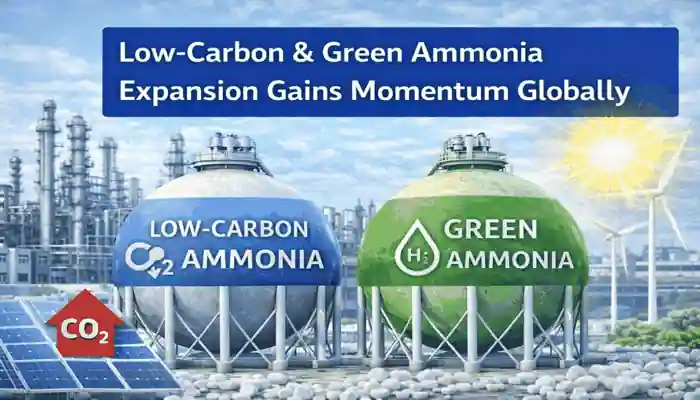
Low-carbon and green ammonia expansion is gaining momentum as fertilizer producers and energy companies accelerate efforts to cut emissions and secure future supply. Rising carbon costs, tighter environmental regulations, and growing demand for clean energy inputs are pushing ammonia beyond its traditional fertilizer role.
During its recent strategy update, Yara International highlighted that low-carbon and green ammonia will play a critical role in the future fertilizer market and the global energy transition.
Low-Carbon Ammonia Becomes a Strategic Priority
Low-carbon ammonia, produced using carbon capture and storage (CCS) or lower-emission energy sources, is emerging as a near-term solution for reducing the carbon footprint of nitrogen fertilizers. Producers are increasingly investing in blue ammonia projects, particularly in regions with access to low-cost gas and CCS infrastructure.
These projects allow companies to reduce emissions while maintaining large-scale production, making low-carbon ammonia commercially viable before green ammonia reaches full scale.
Green Ammonia Expansion Driven by Energy Transition
Green ammonia, produced using renewable electricity and green hydrogen, is gaining attention as a long-term solution for decarbonizing fertilizers, shipping fuel, and power generation. Although production costs remain higher, falling renewable energy prices and government incentives are improving project economics.
Several large green ammonia projects are under development in the Middle East, Europe, Australia, and the United States. These projects target both fertilizer demand and emerging non-fertilizer uses such as clean fuel and hydrogen transport.
Infrastructure and Logistics Shape Expansion Pace
Existing ammonia infrastructure plays a key role in determining where low-carbon and green ammonia projects move forward. Companies with established ammonia terminals, shipping fleets, and distribution networks enjoy a major advantage.
According to industry analysis, access to infrastructure can reduce delivered costs by tens of dollars per tonne, accelerating commercialization and market adoption.
Carbon Pricing and CBAM Support Low-Carbon Ammonia
Carbon pricing mechanisms, including the EU’s Carbon Border Adjustment Mechanism (CBAM), are strengthening the business case for low-carbon ammonia. Products with lower emission intensity face fewer carbon costs, improving competitiveness in regulated markets.
As carbon costs rise, buyers increasingly prefer low-carbon fertilizer products, encouraging further investment across the ammonia value chain.
Implications for India’s Fertilizer and Energy Strategy
For India, low-carbon and green ammonia expansion holds long-term strategic importance. India remains heavily dependent on imported ammonia and urea, and global shifts toward cleaner production will influence future import costs and availability.
India’s green hydrogen and green ammonia ambitions could benefit from global technology progress and falling costs. However, large-scale adoption will depend on policy support, infrastructure development, and renewable energy availability.
Outlook: Gradual Scale-Up with Long-Term Impact
Low-carbon ammonia is expected to scale up first, supported by CCS and existing assets. Green ammonia will follow as renewable power becomes cheaper and more abundant.
Over time, both pathways are likely to reshape fertilizer markets, carbon pricing dynamics, and global ammonia trade flows.