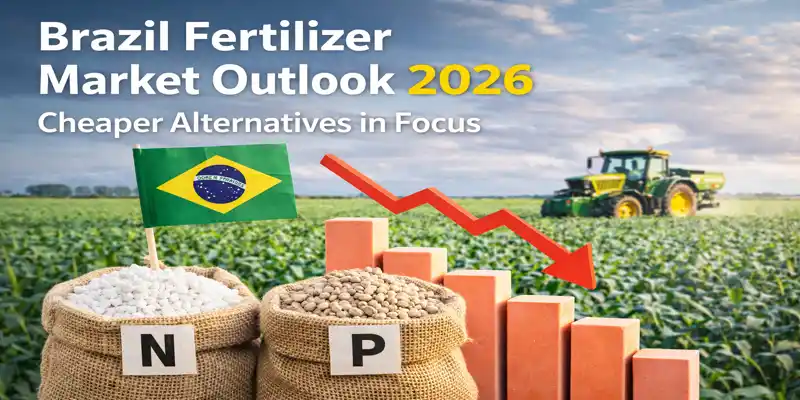
Brazil fertilizer market outlook 2026 points to continued demand for lower-cost alternatives to traditional nitrogen and phosphate fertilizers, according to Milton Sato, head of global market intelligence at Fertistream. Speaking ahead of the Argus Fertilizer Latino Americano conference in Miami, Sato said the Brazil fertilizer market outlook 2026 will be shaped by tight phosphate availability from China and rising regulatory risks in Europe.
Shift Toward Cheaper Nitrogen and Phosphate Options
In 2025, many Brazilian buyers substituted urea with ammonium sulphate (amsul) and replaced monoammonium phosphate (MAP) with NPs, single superphosphate (SSP), and triple superphosphate (TSP). This trend was driven by an unfavourable grain-to-fertilizer price ratio, which pushed farmers to reduce input costs.
Chinese amsul exports are expected to remain a key nitrogen option in 2026. Amsul is not subject to Chinese export quotas and benefits from low production costs due to its by-product nature. In addition to competitive pricing, Brazilian farmers value amsul for its sulphur content.
Phosphate Supply Constraints Persist
Phosphate options remain more limited. Until China resumes phosphate exports — unlikely before April — Brazilian buyers will rely more heavily on imported MAP and TSP. SSP availability is under pressure due to elevated sulphur prices.
China has announced a suspension of phosphate exports until August, mainly to offset rising sulphur costs. However, officials may reassess this policy after the peak domestic season ends in April. Once exports resume, low-concentration NPs may re-emerge as an alternative for Brazilian farmers, while SSP imports will stay on the radar if prices soften.
CBAM Raises Risk of Tight Nitrogen Supply in Europe
The introduction of the Carbon Border Adjustment Mechanism (CBAM) in Europe on 1 January has increased uncertainty for fertilizer traders. As a result, many firms are adopting a cautious approach to avoid regulatory exposure.
European importers front-loaded urea and UAN imports in December, filling inventories and providing short-term relief. However, if CBAM implementation continues unchanged, EU buyers are expected to reduce imports of UAN and CAN due to high carbon-related costs. This could tighten nitrogen supply in the upcoming season.
Impact of Potential EU Duty Changes
If the EU removes most-favoured-nation (MFN) duties on urea, more suppliers will gain access to the market. Egypt and Algeria would lose their exemption advantage, while Middle East producers would become more competitive.
Russian fertilizer exports face additional duties on top of MFN tariffs, rising sharply through 2028. These measures are expected to divert Russian volumes to alternative markets.
Dropping MFN duties on phosphate imports would expand EU sourcing options, including Saudi Arabia, Jordan, the US, Russia, and China.
Ethiopia’s Shift Away From Tenders
Ethiopia’s move toward private negotiations instead of long-term tenders has made its fertilizer imports more responsive to market dynamics. While the transition came at an inopportune time due to tight DAP supply, Ethiopia still secured robust imports of around 1.3mn tonnes in 2025.
This approach may serve as a reference for other African countries seeking greater flexibility in procurement.
Markets Poised for Near-Term Growth
Sato identified the US, India, and Australasia as key growth markets for nitrogen in the next three to six months. In Europe, CBAM is expected to support locally produced CAN, urea, and NPKs.
Chinese exports of amsul and urea are likely to remain strong in 2026. On phosphates, under-application and low inventories in the US and Brazil could drive restocking ahead of key agricultural seasons. India’s fertilizer demand also remains strong due to government concerns over supply security.
Sulphur Prices Set Floor for Phosphates
Sulphur prices rose sharply in 2025 and remain well above historical averages. Higher sulphur costs have lifted phosphate production costs, particularly for SSP, effectively setting a price floor.
Strong sulphur demand from Indonesian nickel production and China, combined with geopolitical risks affecting Russian supply, is expected to keep sulphur prices firm.