
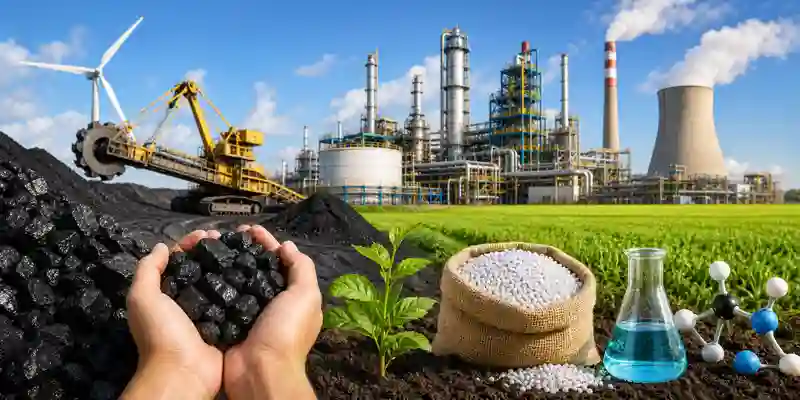
Coal gasification India is emerging as a strategic solution to reduce import dependence and strengthen domestic energy and fertilizer production. The ongoing West Asia crisis has highlighted the need for India to build resilience in energy, petrochemicals, and fertilisers using its vast coal reserves.
India holds the world’s fifth-largest coal reserves, yet it imports nearly 243 million tonnes annually due to quality and supply constraints. At the same time, coal contributes more than 70% of electricity generation, making it central to India’s energy ecosystem.
What is Coal Gasification?
Coal gasification is a process that converts coal into syngas, a mixture of carbon monoxide, hydrogen, methane, and carbon dioxide. This gas can be used to produce:
- Synthetic natural gas
- Methanol and ethanol fuels
- Ammonia and urea fertilizers
- Petrochemicals
Unlike traditional coal burning, gasification is cleaner and more efficient, offering a sustainable alternative for industrial use.
India’s Coal Paradox
Despite having 378 billion tonnes of coal reserves, India faces several challenges:
- High ash content (30–45%) compared to global average
- Around 40% reserves located deep underground
- Geographic concentration in eastern states
These factors increase the cost of extraction and processing, limiting domestic utilization.
Role in Fertilizer and Energy Security
Coal gasification India can play a major role in reducing reliance on imported LNG and fertilizers. Syngas-based production can support:
- Domestic ammonia and urea manufacturing
- Reduced dependence on global energy markets
- Stable input costs for fertilizer production
Countries like China have already leveraged this technology. Around 90% of China’s ammonia and 70% of methanol production comes from coal gasification.
Policy Push and Investments
India has started focusing on coal gasification through policy and funding support:
- National Coal Gasification Mission funding increased significantly
- ₹8,500 crore incentives approved for projects
- Additional investments in coal exploration
Several projects are under development, including:
- Talcher coal-based ammonia-urea complex
- Coal gasification projects by Coal India Limited
- Private sector initiatives
India’s first coal-based urea plant at Talcher is now expected to be completed by December 2027.
Future Outlook Towards 2047
Coal is expected to remain important, though its share in power generation may decline to 27% by 2047. However, gasification offers a way to use coal more efficiently and cleanly.
It also aligns with:
- Energy security goals
- Import substitution strategy
- Net Zero commitments (with CCUS integration)
Challenges and Way Forward
Despite its potential, coal gasification India faces challenges:
- High capital investment
- Technology gaps
- Suitability for high-ash coal
To overcome these, India needs:
- Global technology partnerships
- Strong R&D for indigenous solutions
- Policy support for scaling projects
Conclusion
Coal gasification India represents a transformative opportunity to turn abundant coal reserves into a strategic advantage. By converting coal into cleaner fuels and fertilizers, India can reduce imports, improve sustainability, and strengthen its path toward Viksit Bharat 2047.