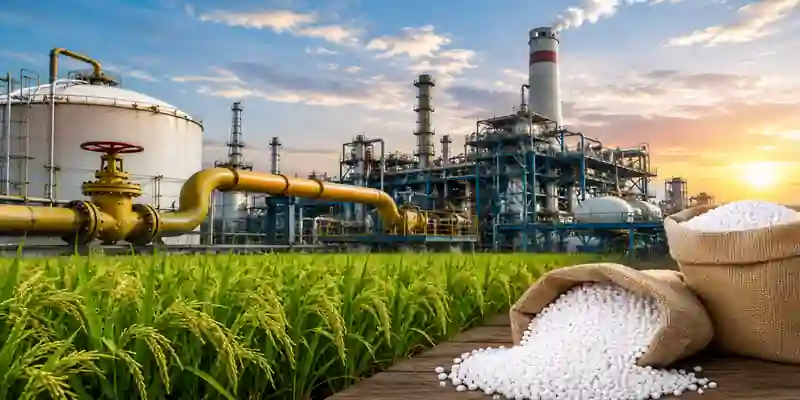
Low-carbon fertilizer collaboration is emerging as a critical lever to cut agricultural emissions without harming crop yields. Fertilizer production and on-farm nutrient use account for a large share of agriculture’s climate footprint. However, farmers still depend on mineral fertilizers to maintain productivity and food security.
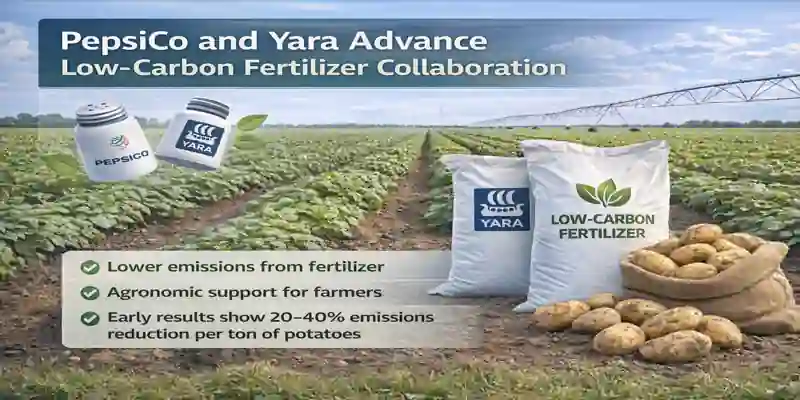
A new low-carbon fertilizer collaboration between PepsiCo and Yara shows how climate action and farm productivity can move forward together. The initiative combines buyer commitments, cleaner fertilizer inputs, agronomic support, and digital monitoring to reduce emissions at scale.
Why fertilizer matters for climate goals
Agriculture produces significant greenhouse gas emissions, and fertilizer plays a central role. Conventional ammonia production depends on fossil fuels and releases carbon dioxide. At the farm level, nitrogen application generates nitrous oxide, a highly potent greenhouse gas.
Despite these impacts, mineral fertilizers remain essential. Around half of global food production relies on them. For this reason, decarbonizing fertilizer is vital for meeting food system climate targets without risking yield losses.
How the PepsiCo–Yara model works
The PepsiCo–Yara approach targets both upstream and field-level emissions. Yara supplies lower-carbon fertilizers produced using renewable energy or carbon capture–enabled ammonia. The package also includes catalytic abatement technology to cut nitrous oxide emissions during production.
On farms, the program applies soil diagnostics, precision nutrient management, and digital tools. These practices improve nitrogen use efficiency and reduce emissions while protecting crop yields and farmer incomes.
Farmer-focused climate action
According to Margaret Henry, Vice-President of Sustainable and Regenerative Agriculture at PepsiCo, collaboration is essential to transform the food system.
She said the partnership places farmers at the centre by helping them adopt regenerative practices, lower emissions, and build long-term resilience across agricultural communities.
Expansion across regions and crops
The initiative began in Europe and later expanded into Latin America. By mid-2025, PepsiCo and Yara rolled out the model in Mexico, Colombia, Chile, and Argentina. The program focuses primarily on potato growers within PepsiCo’s supply chain.
Early results show promising outcomes. Pilot projects suggest emissions reductions of 20 to 40 percent per ton of potatoes, depending on the crop system and fertilizer variant. These results highlight the potential to scale climate-smart fertilizer solutions across diverse farming systems.
Creating demand for low-carbon fertilizers
The rapid geographic expansion signals strong replicability. It also demonstrates how procurement commitments from multinational food companies can create demand for cleaner fertilizers. These signals encourage investment in clean ammonia production and emissions abatement technologies.
Benoit Lamaison, Senior Vice-President for Continental Europe and Product Strategy at Yara, said collaboration across the value chain is essential to decarbonize food production and meet global climate goals.