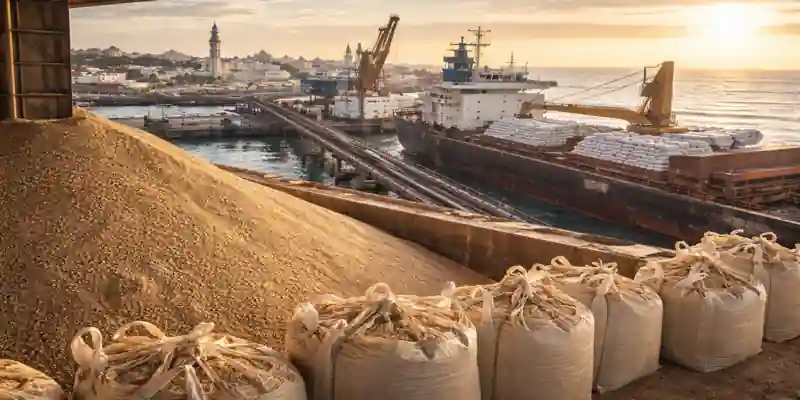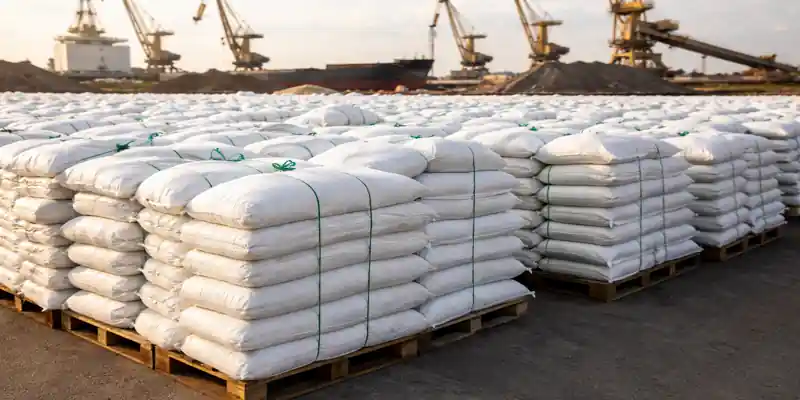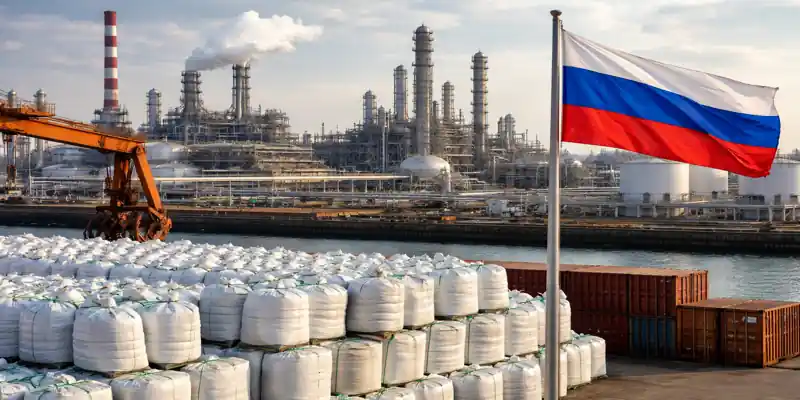

Europe Russian Fertiliser Import issues have become a major concern even as the EU bans Russian natural gas. The bloc is cutting fuel supplies, yet fertiliser — produced using Russian gas — continues to enter Europe in large volumes, exposing a new form of dependency.
Yet beneath the headlines, a surprising contradiction has emerged: while pipeline-gas and LNG imports from Russia are being wound down, Europe continues to import large amounts of Russian fertiliser — especially nitrogen-based fertiliser produced with natural gas. In effect, Europe may still be indirectly dependent on Russian gas, albeit in a different form.
Why Fertiliser — Not Gas — Is Flowing
Production of nitrogen-based fertilisers (e.g. urea, ammonia-based fertilisers) is extremely energy-intensive and requires natural gas both as a feedstock and as energy. Russia retains access to comparatively cheap gas and plentiful production capacity. That allows Russian fertiliser makers to export fertiliser at prices European producers struggle to match.
Since the war began and energy disruption hit Europe, many European fertiliser plants either shut down or scaled back — high energy costs and supply uncertainty made domestic production economically unviable. With domestic output weaker, European farmers and agricultural supply chains turned instead to cheaper, imported fertiliser.
As a result: Russia has steadily increased its share of the EU fertiliser market. In 2025, Russia remains the largest exporter of fertiliser to the EU.
Thus — ironically — while Europe is cutting direct energy dependency (gas/oil), it is deepening a new kind of dependency via fertiliser, which itself is a derivative of fossil-fuel energy.
What the EU Is Doing: Tariffs and Gradual Phase-Out Attempts
Aware of this loophole, EU policymakers have taken steps: in mid-2025 the European Parliament approved tariffs on fertilisers imported from Russia and its ally Belarus. Tariffs started modest but are designed to escalate over several years, aiming to render Russian fertiliser uncompetitive by around 2028.
Moreover, some EU member states have already begun phasing out purchases or completely eliminating imports of Russian fertiliser. The broader goal: to revive domestic fertiliser production (or find alternative non-Russian suppliers), reducing strategic dependence on Moscow.
Still, economists warn tariffs alone may not suffice. Rebuilding a cost-competitive fertiliser industry in Europe — when energy costs remain high — is a slow and expensive process. Meanwhile, farmers who depend on affordable fertiliser may resist sharp price hikes.
Strategic and Food-Security Risks: Why this Matters
Indirect funding for Russia’s war machine: Even after banning Russian gas, Europe may still be providing billions of euros to Russia via fertiliser imports. That undermines the logic of sanctions as a cohesive strategy.
Food-security vulnerability: Fertiliser is a key input for agriculture. If fertiliser from Russia becomes scarce — because of tariffs, supply cuts, or geopolitical escalation — European food production could suffer. That may lead to crop-yield reductions, higher food prices, and broader economic stress for farmers and consumers.
Dependency disguised as normal trade: Because fertiliser trade doesn’t look like energy trade, it may escape scrutiny. Yet the same underlying resource — Russian gas — funds it. The structural dependency remains.
Competitive squeeze on European fertiliser industry: As long as cheap Russian fertiliser floods the market, European producers struggle to compete, discouraging domestic investment and undermining long-term resilience.
What Europe Needs — And What It Should Watch
For Europe’s broader strategy to work — to truly sever dependence on Russian energy while safeguarding food security — it needs a comprehensive plan that goes beyond gas. Key steps could include:
Incentivizing domestic fertiliser production (possibly shifting to alternative energy inputs, or greener production processes).
Diversifying fertiliser import sources beyond Russia/Belarus, including other global producers.
Supporting farmers to manage price volatility — perhaps via subsidies, price-support mechanisms or gradual transition plans.
Treating fertiliser imports as part of strategic trade policy — not just agriculture or commerce — because they carry geopolitical risk.
Monitoring supply-chains more transparently to avoid disguised gas-dependency via fertiliser.
Conclusion
Europe’s decision to ban Russian gas imports was widely hailed as a turning point in the attempt to choke off revenue streams funding the war in Ukraine. But the persistence — and growth — of fertiliser imports from Russia shows how economic ties adapt. As things stand, Europe may be replacing one form of dependence (gas) with another (gas-based fertiliser), preserving a critical revenue line for Russia and maintaining a strategic vulnerability that undercuts the intent of its sanctions.
This dynamic underscores a broader lesson: true decoupling from a resource-dependent adversary may require addressing not just direct commodity trade, but also derivative products and supply webs — especially ones as central as fertiliser, which undergirds food security.