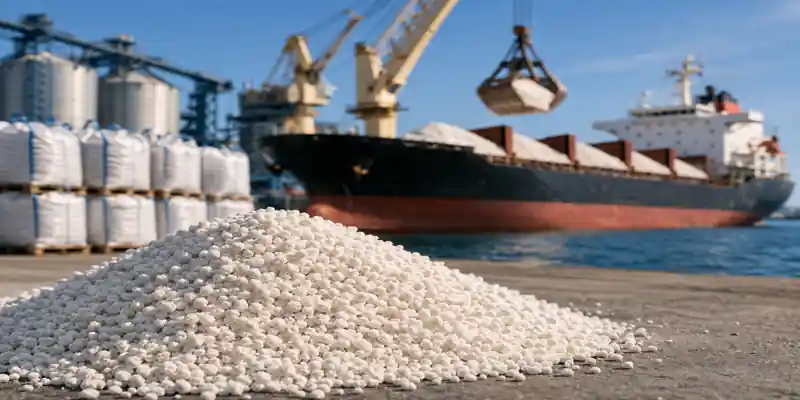

Fertilizer import dependence increased sharply during April–November 2025, according to provisional data released by the Fertilizer Association of India (FAI). The data highlights a clear rebalancing of India’s fertilizer supply chain, with imports playing a central role in ensuring nutrient availability during critical crop nutrition months.
The report shows uneven trends across nutrients. While sales remained stable or grew modestly, domestic production weakened for key fertilizers. Imports filled the gap to maintain uninterrupted supply to farmers.
Urea: Imports Compensate for Lower Production
Urea sales reached 25.40 million tonnes, up 2.3% year-on-year. However, domestic production declined 3.7% to 19.75 million tonnes. In contrast, urea imports surged 120.3% to 7.17 million tonnes, nearly doubling from last year.
In November alone, urea sales rose 4.8% to 3.75 million tonnes. Imports jumped 68.4% to 1.31 million tonnes. This surge reflects planned supply management during peak nutrient demand.
S. Sankarasubramanian, Chairman, FAI, said the data shows a strategic shift. He noted that import planning has become essential to ensure uninterrupted farmer access to fertilizers.
DAP: Import Reliance Deepens
DAP sales stood at 7.12 million tonnes, marginally lower by 1.0%. Domestic production fell 5.2% to 2.68 million tonnes. Imports now meet 67% of total DAP demand, compared with 56% last year.
This trend confirms India’s rising dependence on phosphatic imports to sustain fertilizer availability despite flat demand.
NP and NPK: Balanced Nutrients Gain Ground
NP and NPK fertilizer sales reached 10.38 million tonnes, up 0.1%. Production increased 13.8% to 8.15 million tonnes. Imports nearly doubled, rising 98.7% to 2.72 million tonnes.
This growth reflects farmers’ preference for balanced fertilizers tailored to crop and soil needs.
MOP and SSP: Diverging Trends
MOP sales increased 8.6% to 1.55 million tonnes, indicating steady demand.
Single Super Phosphate (SSP) showed strong domestic momentum. Production rose 9.5% to 3.97 million tonnes, while sales jumped 15.0% to 4.16 million tonnes.
SSP’s performance highlights growing farmer confidence in indigenous phosphatic fertilizers.
Structural Shift in Fertilizer Supply
Overall, fertilizer import dependence is no longer temporary. Urea imports rose 120%, DAP imports 54%, and complex fertilizer imports 98.7%. Imports have become a structural pillar of India’s fertilizer planning.
Suresh Kumar Chaudhari, Director General, FAI, said the sector now follows a dual strategy. India secures critical nutrients through imports while strengthening domestic phosphatic production. FAI will continue data-driven planning to support sustainable agriculture.
📊 Fertilizer Production, Imports & Sales Snapshot
(April–November 2025 | Provisional Data – Fertilizer Association of India)
| Fertilizer | Production | Imports | Sales | Key Insight |
|---|---|---|---|---|
| Urea | ▼ 3.7% (19.75 MT) | ▲ 120.3% (7.17 MT) | ▲ 2.3% (25.40 MT) | Sharp import surge offsets lower domestic output |
| DAP | ▼ 5.2% (2.68 MT) | ▲ 54.4% (5.54 MT) | ▼ 1.0% (7.12 MT) | Imports meet ~67% of total demand |
| NP / NPK | ▲ 13.8% (8.15 MT) | ▲ 98.7% (2.72 MT) | ▲ 0.1% (10.38 MT) | Rising preference for balanced nutrients |
| MOP | — | ▼ 25.0% (1.95 MT) | ▲ 8.6% (1.55 MT) | Solid demand despite lower imports |
| SSP | ▲ 9.5% (3.97 MT) | — | ▲ 15.0% (4.16 MT) | Strong indigenous phosphatic growth |