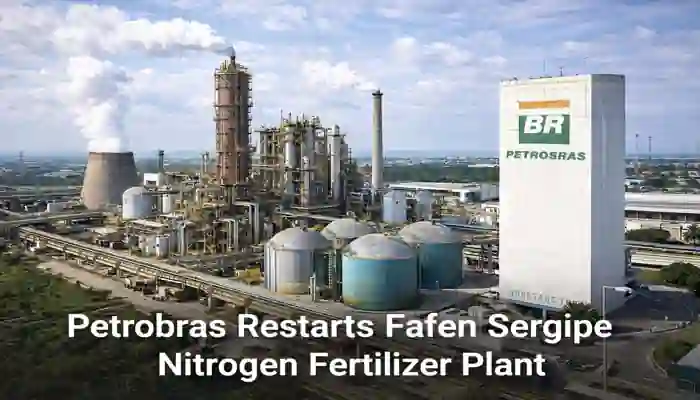
Petrobras Fafen Sergipe restart has officially ended a 21-month production halt at the nitrogen fertilizer plant in northeastern Brazil. The Petrobras Fafen Sergipe restart confirms the resumption of ammonia production at the Fabrica de Fertilizantes Nitrogenados (Fafen) facility located in Laranjeiras, Sergipe state.
The announcement was made by Petrobras president Magda Chambriard through social media and was later confirmed by the Sergipe state government. Ammonia production at the plant resumed on 31 December, marking a significant step in Petrobras’s renewed focus on the fertilizer sector.
Production Capacity at Fafen Sergipe
The Fafen Sergipe unit has substantial installed capacity. Once fully operational, the plant can produce:
650,000 tonnes per year of urea
450,000 tonnes per year of ammonia
320,000 tonnes per year of ammonium sulfate
These volumes position the plant as a key contributor to Brazil’s domestic nitrogen fertilizer supply.
Background of the Production Halt
Operations at Fafen Sergipe were suspended in March 2024 while the facility was under the management of Brazilian chemical company Unigel. The company also operated another Fafen unit in Camaçari, Bahia.
Unigel faced severe financial stress and filed for bankruptcy protection twice, which ultimately disrupted operations at both fertilizer plants.
Petrobras Regains Control of Fafen Units
In response to Unigel’s financial difficulties and as part of its long-term fertilizer strategy, Petrobras initiated the process to regain control of the Fafen plants in April 2025.
As part of the restart plan, Petrobras signed a contract in September 2025 with Brazilian industrial maintenance and management firm Engeman. The agreement covered technical work required to resume operations at the fertilizer units.
Strategic Importance for Brazil’s Fertilizer Supply
The Petrobras Fafen Sergipe restart aligns with the company’s broader strategy to reduce Brazil’s dependence on imported fertilizers. Domestic nitrogen production remains a priority for the country, particularly for urea and ammonia used in agriculture.
Industry observers expect the restart to improve supply security and support Brazilian farmers ahead of upcoming planting seasons.