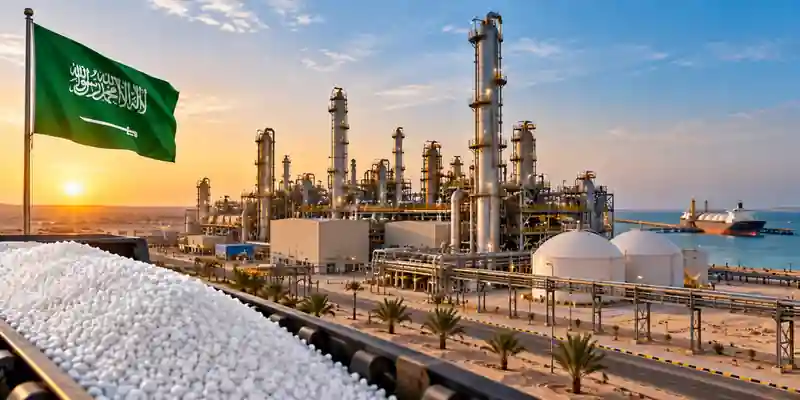
The Sabic AN urea plant project has moved forward after the Saudi Arabian fertilizer producer approved the final investment decision (FID) for a new 2.6 million tonnes per year (mn t/yr) urea facility. Commercial production is targeted for the fourth quarter of 2030.
The new project will also include a 1.2mn t/yr ammonia facility and a post-combustion carbon capture unit, strengthening Sabic AN’s position in Saudi Arabia’s fertilizer industry.
Sabic AN urea plant construction to start in 2026
Construction of the new Sabic AN urea plant is scheduled to begin in the fourth quarter of 2026, according to a filing with the Saudi stock exchange.
The project is expected to significantly expand the company’s urea production capacity. Once operational, annual urea capacity will increase from approximately 4.8mn t/yr to 7.4mn t/yr, representing an increase of more than 50%.
The Saudi energy ministry approved the allocation of natural gas for the project in late March, clearing an important requirement for the development of the new production complex.
$3.5 billion EPC contract awarded to Samsung
The engineering, procurement and construction (EPC) contract for the new fertilizer facility has been awarded to Samsung, with the project valued at approximately $3.5 billion.
The combination of new urea and ammonia capacity is expected to expand Saudi Arabia’s exportable fertilizer volumes while supporting the country’s broader industrial and energy-sector development.
Sabic AN remains Saudi Arabia’s sole urea producer
SABIC Agri-Nutrients Company is currently the sole supplier of urea in Saudi Arabia.
The company traditionally produces and loads most of its urea from Jubail. However, disruptions caused by the conflict in the Middle East have required the producer to also load fertilizer cargoes from Yanbu on Saudi Arabia’s west coast.
Sabic AN exports a large share of its production to international markets. Industry estimates indicate that the company exported approximately 4.1mn-4.2mn tonnes of urea in 2025.
Ibn Al-Baytar integration adds further capacity
Sabic AN also announced plans earlier in 2026 to incorporate the Ibn Al-Baytar plant into its existing portfolio.
The integration is expected to add slightly less than 500,000 tonnes per year of urea capacity, taking the company’s overall capacity to just above 4.8mn t/yr before the new project is completed.
The additional capacity from the new project will subsequently take total annual urea production capability to around 7.4mn tonnes.
Gulf fertilizer capacity set to expand
Sabic AN is not the only producer planning a major increase in urea capacity in the Middle East.
QatarEnergy has announced plans for a new fertilizer complex that would increase Qatar’s urea production capacity to approximately 12.4mn t/yr, effectively doubling its existing capacity.
The project is among the major urea developments expected to be completed in the Gulf region by 2030, excluding Iran.
Outlook for the global urea market
The expansion of production capacity in Saudi Arabia and Qatar could have implications for the international urea market, particularly because both countries are major exporters.
Additional Gulf production capacity could increase the availability of urea for international buyers and strengthen the region’s role in global fertilizer trade.
For Sabic AN, the new 2.6mn t/yr urea facility represents a major expansion of its production base. With commercial production scheduled for late 2030, the project will be an important addition to global urea capacity over the coming decade.