The fertilizer industry has renewed its demand to bring urea under the Urea Nutrient-Based Subsidy (NBS) regime to address the growing imbalance in fertilizer consumption across India. Industry experts believe that including urea in the Urea Nutrient-Based Subsidy (NBS) framework would help promote balanced nutrient application and improve soil health.
Suresh Kumar Chaudhari, Director General of the Fertiliser Association of India (FAI), said pricing distortion remains the key reason for excessive nitrogen consumption in agriculture. According to him, bringing urea under the NBS system would significantly improve nutrient balance in fertilizer usage.
He clarified that the core issue is not the overuse of fertilizers but the imbalance in nutrient application, particularly the disproportionately high use of nitrogen through urea.
Urea Nutrient-Based Subsidy (NBS) and Fertilizer Subsidy Structure
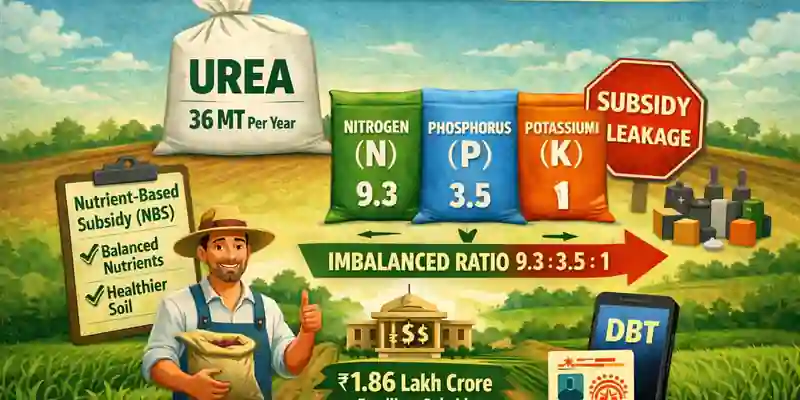
As per revised estimates, the government has pegged the fertilizer subsidy for FY26 at ₹1.86 lakh crore, including ₹1.26 lakh crore for urea and ₹60,000 crore under the NBS scheme. The budget estimate for FY27 stands at ₹1.71 lakh crore, with ₹1.16 lakh crore allocated for urea and ₹54,000 crore for NBS fertilizers.
Currently, urea is sold to farmers at a notified maximum retail price of ₹242 per 45-kg bag, unchanged since March 2018. The government bears nearly 90% of the subsidy cost.
In contrast, phosphatic and potassic (P&K) fertilizers were decontrolled in 2010 when the government introduced the Nutrient-Based Subsidy regime. Under this system, subsidy rates are announced twice a year for the kharif and rabi seasons.
Distorted Fertilizer Consumption and Urea Nutrient-Based Subsidy (NBS)
India’s fertilizer consumption pattern remains heavily skewed toward nitrogen. Against the recommended 4:2:1 ratio of nitrogen (N), phosphorus (P), and potassium (K), the current consumption pattern is approximately 9.3:3.5:1.
This imbalance is largely attributed to the continued exclusion of urea from the NBS framework.
A recent study by ICRIER noted that the existing fertilizer subsidy policy distorts both markets and soil health. The study recommended rationalising subsidies by reducing support for nitrogen while increasing incentives for phosphorus and potassium without raising the overall subsidy burden.
India supplies around 64 million tonnes of subsidised fertilisers annually, of which urea accounts for nearly 36 million tonnes.
Urea Nutrient-Based Subsidy (NBS) and DBT Challenges
The fertilizer industry has expressed readiness to support the government’s Direct Benefit Transfer (DBT) initiatives to ensure subsidies reach genuine farmers. However, creating a unified agricultural database remains a major challenge.
Fragmented landholdings, tenancy farming, and absentee land ownership make it difficult to identify actual beneficiaries of fertilizer subsidies.
Preventing Diversion Under Urea Nutrient-Based Subsidy (NBS)
The Parliamentary Standing Committee on Chemicals and Fertilisers (2025–26) recently raised concerns about the diversion of subsidised fertilizers, especially urea, for non-agricultural purposes.
The committee noted that subsidised urea is vulnerable to:
Stocking and black marketing
Industrial use in resins, adhesives, plastics, foams, textiles, leather, and paper industries
It recommended expanding pilot projects for direct cash transfer of fertilizer subsidies across selected districts.
The panel also suggested integrating Aadhaar-based authentication systems with the digital farmers’ registry and PM-Kisan database to improve subsidy targeting.
Nano Fertilisers and Urea Nutrient-Based Subsidy (NBS)
On nano fertilisers, industry experts said these products are promising but require more long-term scientific validation. Early claims suggesting nano fertilisers could replace conventional fertilizer bags were not scientifically accurate.
IFFCO launched nano urea (liquid) in June 2021 and later introduced nano DAP in April 2023 to reduce import dependence.