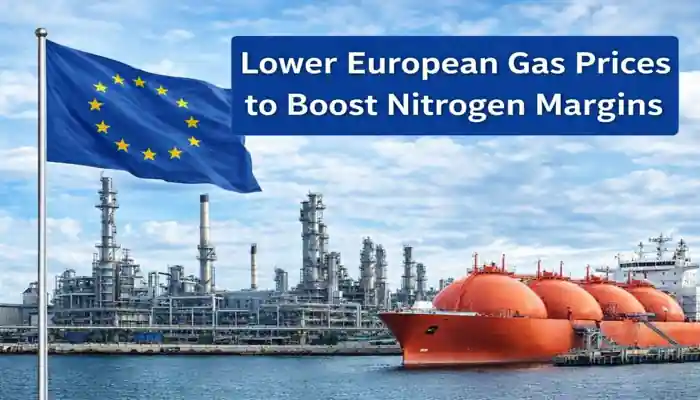
Lower European gas prices are expected to boost nitrogen margins and improve the competitiveness of fertilizer producers in the region. Falling natural gas costs, driven by rising LNG supply and improved energy security, are reshaping the European nitrogen fertilizer market.
European gas prices declined sharply in 2025 compared with previous years. This trend has reduced production costs for nitrogen fertilizers, including urea, ammonium nitrate, and CAN. As a result, producers with operating plants in Europe are seeing stronger margins despite ongoing market volatility.
Lower European Gas Prices Improve Nitrogen Economics
Natural gas is the largest cost component in nitrogen fertilizer production. When gas prices fall, production margins expand immediately. According to market analysis highlighted by Yara, increasing global LNG capacity has played a key role in stabilizing European gas prices.
New LNG export projects, particularly from the US and other regions, have increased gas availability in Europe. This shift has reduced Europe’s dependence on spot gas markets and limited extreme price spikes.
Nitrogen Margins Rise Despite Competitive Imports
Lower European gas prices have helped nitrogen producers defend margins even as imported fertilizers remain available. While imports continue to compete in the European market, reduced energy costs allow local producers to operate more efficiently.
In addition, carbon-related costs such as EU ETS and CBAM are narrowing the gap between domestic and imported fertilizers. This further supports nitrogen margins for European producers with lower carbon intensity.
European Nitrogen Producers Gain Cost Advantage
With gas prices easing, European nitrogen plants have improved operating rates. Several producers that previously curtailed output due to high energy costs are now running at higher utilization levels.
This recovery strengthens Europe’s nitrogen supply position and reduces reliance on imports. Producers with flexible ammonia sourcing and efficient assets benefit the most from the current gas price environment.
Impact on Global Nitrogen Trade Flows
Lower European gas prices are also influencing global nitrogen trade flows. Europe’s improved production economics could limit import demand during peak seasons, tightening availability for other importing regions.
For countries like India, which depend on global nitrogen supply, stronger European production could affect international price trends and tender dynamics.
Outlook: Nitrogen Margins to Stay Supported
Looking ahead, nitrogen margins in Europe are likely to remain supported if gas prices stay stable. Continued LNG capacity additions and improved energy infrastructure reduce the risk of extreme price volatility.
However, geopolitical risks and weather-related disruptions remain key factors to watch. Any sharp rebound in gas prices could quickly pressure nitrogen margins again.