Import bill rises on strong fertiliser demand
India fertiliser imports surge sharply in the current fiscal year, with total imports expected to jump 76 percent to a record $18 billion. Strong monsoon rainfall boosted fertiliser consumption and encouraged farmers to expand crop acreage. As a result, the India fertiliser imports surge reflects higher demand for urea and diammonium phosphate (DAP).
Government officials said higher urea and DAP purchases are pushing up the overall fertiliser import bill. In the first nine months of the fiscal year ending in March, fertiliser imports rose 71 percent year-on-year to $13.98 billion.
March quarter shipments to add further pressure
Large volumes of urea and other fertiliser cargoes are scheduled to arrive in the March quarter. These shipments could add at least another $4 billion to the import bill. India spent $10.23 billion on fertiliser imports in the previous fiscal year.
In 2022–23, fertiliser imports hit an all-time high of $17.21 billion after global prices surged following the Russia–Ukraine conflict.
Fertiliser consumption rises after good monsoon
Fertiliser consumption is expected to increase by at least 5 percent this year. Above-normal rainfall during the monsoon improved soil moisture and supported higher planting, said P.S. Gahlaut, Managing Director of Indian Potash Limited.
India received 8 percent above-average rainfall during the June–September monsoon. October rainfall was also 49 percent higher than normal. These conditions supported winter crops such as wheat, rapeseed, and chickpeas.
Higher acreage boosts urea demand
Farmers planted winter crops on 65.23 million hectares since October 1. This marks a 3.3 percent increase from last year, according to agriculture ministry data.
Urea consumption rose due to strong rice acreage and back-to-back good monsoons, said S. Sankarasubramanian, Chairman of the Fertiliser Association of India. Increased maize production also lifted urea demand.
Urea and DAP imports to rise sharply
Urea imports could rise by as much as 61 percent to around 9 million metric tonnes. DAP imports may increase 52 percent to nearly 7 million tonnes. India sources most of its urea and DAP from Oman, Russia, China, Saudi Arabia, and Morocco.
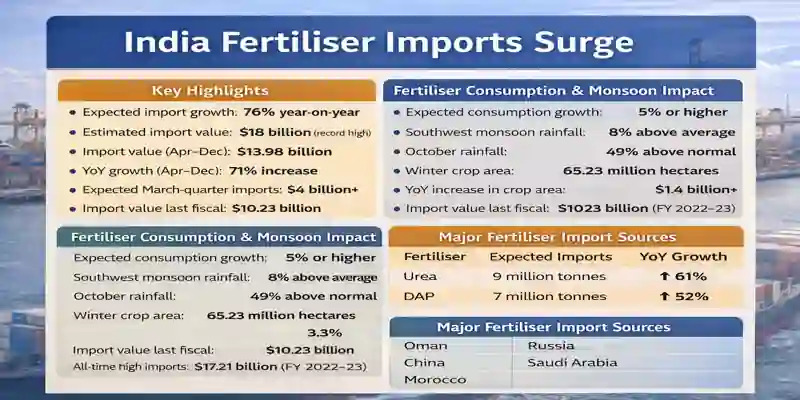
Key Highlights: India Fertiliser Imports (Current Fiscal)
| Parameter | Details |
|---|---|
| Expected import growth | 76% year-on-year |
| Estimated import value | $18 billion (record high) |
| Import value (Apr–Dec) | $13.98 billion |
| YoY growth (Apr–Dec) | 71% increase |
| Expected March-quarter imports | $4 billion+ |
| Import value last fiscal | $10.23 billion |
| All-time high imports | $17.21 billion (FY 2022–23) |
Fertiliser Consumption & Monsoon Impact
| Indicator | Status |
|---|---|
| Expected consumption growth | 5% or higher |
| Southwest monsoon rainfall | 8% above average |
| October rainfall | 49% above normal |
| Winter crop area | 65.23 million hectares |
| YoY increase in crop area | 3.3% |
Urea & DAP Import Outlook
| Fertiliser | Expected Imports | YoY Growth |
|---|---|---|
| Urea | 9 million tonnes | ↑ 61% |
| DAP | 7 million tonnes | ↑ 52% |
Major Fertiliser Import Sources
| Country |
|---|
| Oman |
| Russia |
| China |
| Saudi Arabia |
| Morocco |